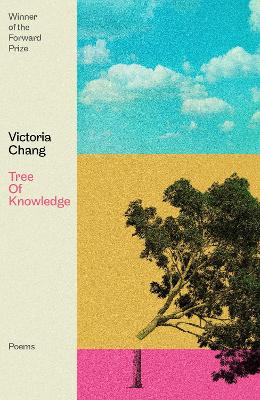
Tree of Knowledge
Victoria Chang
£16.99
Description
‘A poet of precision, intellect and considerable emotional heft’ ROXANE GAY
‘Chang’s latest collection continues her engagement with visual art […] creating space for Chang to meditate on language, grief and our relationship to history . . . Evocative’ GUARDIAN
A poet watches the limbs of a eucalyptus tree get sawed off: the image persists, recurring across poems of art, language, selfhood, memory, and loss.
Joan Mitchell said, When I talk about love, I mean loving a tree. When I talk about love, I mean loving where a tree used to be.
Men assess the eucalyptus tree growing on the poet’s street; a crane arrives. The sound of a chainsaw rings in the air and branches begin to fall. This tree-cutting haunts the poet, and refracts across the remarkable work collected in Tree of Knowledge as Chang turns her thoughts to artists such as Pablo Picasso, Joan Mitchell and Hilma af Klint.
Roving, evocative, and intricate, Tree of Knowledge is rooted in Victoria Chang’s crystalline voice and generous, probing gaze, and by certain images trees, a hanging figure, a branch, fingertips, a briefcase that resurface like apparitions.
Publisher Review
Chang changes the way readers see art, the world, and themselves in this contemplative epic that rivals the major works of Wallace Stevens and A. R. Ammons * Library Journal, *Starred Review* * Chang’s latest collection continues her engagement with visual art […] creating space for Chang to meditate on language, grief and our relationship to history. The poems are haunted by the image of a eucalyptus tree cut down on the poet’s street, leaving a poignant absence . . . Evocative * Guardian * Illustrated with embroidered photo collages, the ambitious latest from Chang delivers an incisive midlife meditation on history, nature, and art . . . Readers will revel in the exquisite balance achieved by each poem. This is a work of rapture and hard-won revelation. * Publisher’s Weekly (starred review) * These poems, aesthetically satisfying and engaging throughout, succeed by refining rather than foregoing Chang’s favoured strategies, particularly a penchant for ekphrasis, paradox and syntactic randomness . . . The collection as a whole develops a distinct outlook on tragedy and grieving, one which seeks to bind individual and collective sorrows together in new and disconcerting ways. * The London Magazine * Victoria Chang’s poetry is transcendent; it doesn’t observe and identify social and environmental injustices so much as it travels past them to gaze at the world where such things originate … As a kind of cartographer, [Chang] explores and then returns to bear witness to a place wholly unknown to us, but visible, just beyond the ranges of bitterness, rage, hatred, and shame — Rick Bass Stunning . . . The bar is raised again. Chang is, for my money, one of the best practitioners of ekphrasis today [and Tree of Knowledge] takes Chang’s engagement with visual art to a new, richer level . . . An impressive collection . . . That Chang’s poems are both humane and imbued with a deep philosophical quality is a rare feat — Rishi Dastidar, Telegraph * ‘Best poetry books of 2026’ *
Find this book on the following lists
-
July 2026 New Releases: Poetry
Browse The List
Book experts at your service
What are you looking for?