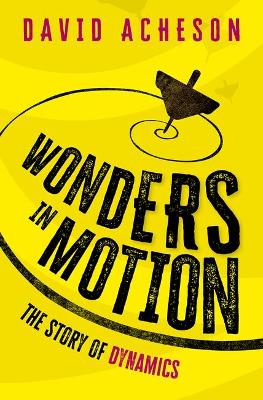
Wonders in Motion
David Acheson
£15.99
This book is scheduled to be published on 24/09/2026.
You can order it now and we'll ship it once available.
Description
What makes an aeroplane fly? Why aren’t rollercoasters circular? And how long would it take to fall right through the Earth?
This wide-ranging popular introduction to the science of motion tells the story of how dynamics developed, from Galileo’s time to the present day. Including such exciting discoveries as the motion of the planets, the dynamics of spinning objects, wave motion, elasticity, and fluid mechanics, the book explains the physical phenomena involved, especially those that surprise us and most challenge our elementary intuition.
The book brings the fundamental principles of mechanics to life by tackling a wide variety of real-world questions, such as why modern-day loop-the-loop rollercoasters are not circular, why skaters on ice spin faster when they draw in their arms, and how a falling cat, initially upside-down, can sometimes manage to land on its feet. The book also explores the idea that classic problems in mechanics can often acquire a wholly new life by being given a sudden and unexpected modern ‘twist’, including, for example, the role played by the gravitational three-body problem in the Apollo moon missions of the 1960s.
Written in an informal and accessible style, yet underpinned by rigorous scholarship and historical research, this book shows that, even after all these years, classical mechanics still has the potential to surprise us and challenge our understanding of how the world around us really works.
Publisher Review
In this book, David J. Acheson invites readers on a lively journey through mathematics and mechanics, where simple curiosities open onto deep and beautiful ideas. From Galileo and Newton’s Principia to Euler, Bernoulli, Hamilton, and Poincare, amongst many other scientific luminaries, the story unfolds through chiral tippy-tops, double pendulums, vortex rings, waves of every kind, and the Golden ratio appearing in an unexpected place. Enriched by hand-drawn sketches and historical gems-from 15th-century manuscripts, to clapping insect wings and earthquakes at Dogger Bank-the book is written with warmth, wit, and clarity. With concise notes for each chapter, it presents mathematics as a creative, human adventure: surprising, illuminating, and a pleasure to read. * John A. Adam, Professor Emeritus of Mathematics, Old Dominion University * An original approach to the mathematics of motion, from the planets to spinning bathwater. David Acheson makes tricky principles simple and convincing and explodes a few myths along the way. Fun, highly informative, and a real bargain. * Ian Stewart, Author of Reaching for the Extreme * Acheson has produced a real treasure in Wonders in Motion. An erudite and gentle introduction to the vibrant world of dynamics. A magical melding of mystery, history and mathematical genius. Here, set amidst an A-list of the greatest names in mathematics and physics the reader will find such wonders as the chiral tippy-top, leap-frogging vortices, solitons, the upside-down pendulum, and the cat-turning problem. Acheson has produced an infectious and enthusiastic read. * Martin Beech, author of Mind the Gap * This is a wonderful, whistle-stop tour of the world of dynamics. Starting in Pisa, where Galileo set the ball rolling, via rollercoasters, falling cats, toy spiders, and cups of tea, and ending in Oxford with an upside down yet stable triple pendulum, Acheson illustrates the basic principles and challenges our intuition in equal measure. * Chris Linton, Emeritus Professor of Mathematics, Loughborough University * Just over three decades ago, I bought Acheson’s Elementary Fluid Dynamics. It is a short, and elegant, and lucid book that is at least partly responsible for me becoming a fluid dynamicist. I have recommended it to many people. From the same pen, Wonders in Motion is a delightfully original, amusingly quirky, and characteristically insightful upending of the normal presentation of this subject. * Thomas Povey, author of Professor Povey’s Perplexing Problems * This book is a delight. It makes a traditionally tricky subject both accessible and enjoyable. David Acheson is to be congratulated for using the rich history of dynamics to such excellent effect. * June Barrow-Green, Emeritus Professor of History of Mathematics, Open University * In this beautifully written and entertaining book, David Acheson takes us on a captivating journey exploring classical dynamics from the time of Galileo to the present day. The various chapters explain clearly the underlying mathematical foundations and how they apply to a host of problems, including, for example, planetary motion, shock waves, and how aeroplanes fly. By combining the mathematics with fascinating historical anecdotes and references (from Newton’s Principia to, more surprisingly, The Ladies’ Diary), the book is an absolute pleasure to read. * David W. Hughes, Professor of Applied Mathematics, University of Leeds * A wonderfully entertaining, often surprising, and completely compelling journey through the science of how things move. * Lucie Green, Professor of Solar Physics, Mullard Space Science Laboratory, UCL *
Book experts at your service
What are you looking for?