The new issue of The Deep Read is here, where we are delighted to feature some great authors and new books!
This month, legendary Argentinian author César Aira introduces the exuberant and transgressive novelist Copi, whose City of Rats is published in the UK for the first time. There is also a Q&A with friend of the shop Hannah Richell, whose latest novel One Dark Night is now out in paperback. And Tom celebrates the return of Don Winslow…
The Artist Who Couldn’t Draw, The Author Who Couldn’t Write
COPI, whose given name was Raul Damonte (Buenos Aires, 1940-Paris, 1987), was a cartoonist, novelist, playwright and actor. He was Argentine, Uruguayan, French, and Italian.
He was a great artist (a great among the greatest) but he used his genius to carve out a marginal place for himself, where he could be mistaken for a nonartist, a dilettante. He was highly undefined, which is why he could do everything. He didn’t know how to do anything, which is why he could be anything he wanted. But he didn’t desire anything, which is why he could pierce through all the membranes of reality and fiction, of life and death. He was not a Frenchman born in Argentina, nor an Argentine exiled in France, nor a Franco-Argentine acting in Italian, nor an Italian in Uruguay.
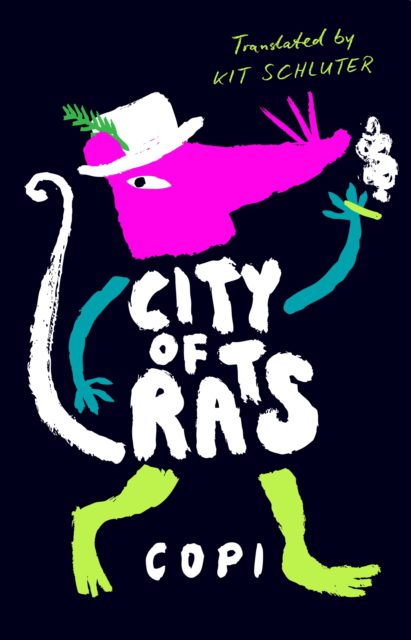
He was, at the outset, an illustrator who did not know how to draw, and who drew wonderfully. “It took me my whole life to learn to draw like a child,” Picasso once said. He was referring to a discontinuity between art and art, which makes it impossible for ordinary people. It is miraculous when a human being makes the leap and becomes an artist. That leap, that miracle, was the life of Copi, who didn’t know how to write, neither in French nor in Spanish, of course, and yet he wrote some of the most beautiful books in either language: L’Uruguayen (The Uruguayan), Le bal des folles (The Queens’ Ball), La cité des rats (City of Rats), La vida es un tango (Life is a Tango). His entire body of work is marked by a lack of memory. He is like Isak Dinesen, who once, when dictating a novel, made a character appear who had died chapters before. When her secretary pointed this out to her, the baroness replied: “My dear, that is of no importance whatsoever.” In Copi, each page is forgotten with the arrival of the next.
Here’s the thing: Copi himself forgot that he couldn’t write or draw. After all, what is there between a thing and its memory if not time? And that can never appear in a drawing. (Time is the archaeological remnant of an old sentimental literature that no longer moves us.)
With theatre, the story was a bit different. Because the world is a theatre, at least for a Baroque man, and Copi was a Baroque man —a Shakespeare, a Calderón, magically reincarnated in gay Paris. That the theatre contained the world, and vice versa, was a natural necessity of the same system of transformations that made him child and adult, artist and nonartist, man and woman. And also alive and dead, because he knew how to make death itself participate in his method of transformations and reversibilities. In one of his best plays, Les quatres jumelles (The Four Twins), the characters die and are reborn about twenty times each, and it’s perfectly plausible.

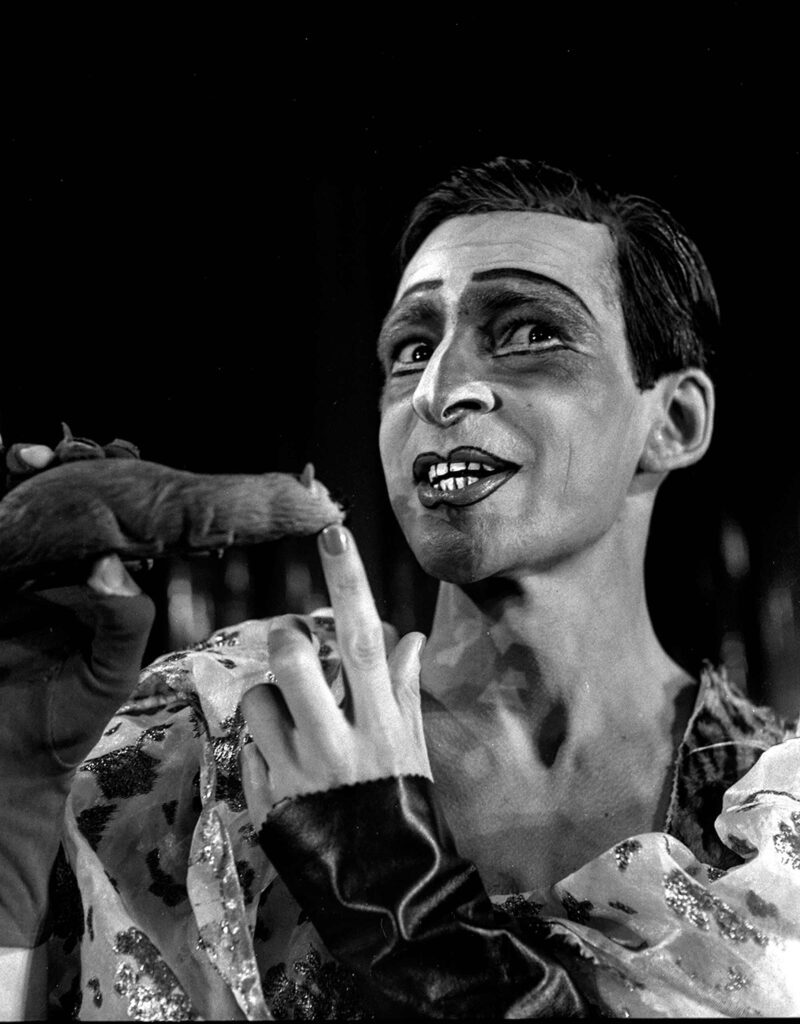
Because Copi was not a surrealist, or an absurdist, or a magician. He was a realist, except that he worked with drawings, and he didn’t know how to draw. Children don’t know how to draw; they know what they want to draw. They want to draw, for example, a spaceship with the computer out of sync because of the laser beam shot at it by a magnetic King Kong aboard a pirate galleon that has been attacked by a panda shark with two nephews, one good and one bad. They are able to draw because they don’t know how. Children, like accomplished artists, are possessed of a positive and free will. It’s not omnipotence, it is reality, plain and simple, life accepted as a process of becoming. The great Yes of a new style of Renaissance man. Becoming has desubstantialized the world, has stripped it of all its significations, has transformed it into a life— into Copi’s exemplary lives.
If we do not recognize at first glance the world-life that is art, it is because its dimensions are different. Space-time is a maquette. Copi is the greatest miniaturist of our time; everything happens on a small canvas the size of the eye, and very quickly. In general, critics agree that reading Copi draws us in, engulfs us, but not all of them point out that, before this irresistible impulse, there is a transposition to the microscopic, or rather subatomic, level. There we find once more the vicissitudes of our existence, but organized in a new way. Heisenberg’s principle provides an explanation: there is a state so small that qualities cease to apply to things, and it all begins to float freely, qualities and things, as well as time, place, relationships, perception, as in a democratic family reunion. That is called the “uncertainty principle,” but only because the observer continues to believe he is Gulliver in Lilliput. Copi generalizes, and so do we, when we become Copi (and we have no choice but to do so); we float on the same level as everything else, and our dreams, fingers, desires, hair, ideas, clothes, memories, certainties and uncertainties, near or far, do too.
By César Aira
Thanks to Vintage Books, who allowed us to print this forward written by César Aira to their release of City of Rats by Copi.
Click here to buy your copy of City of Rats.
César Aira, who Roberto Bolaño called “one of the three or four best writers working in Spanish today”, is the author of more than 100 novels, many of them masterpieces in miniature, including The Proof, The Little Buddhist Monk, and The Lime Tree.
Author Q&A: Hannah Richell
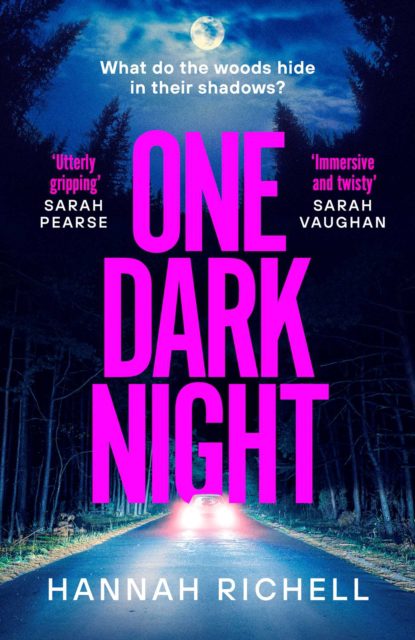
Hannah Richell is a novelist and longstanding friend of Mr B’s – her latest novel, the spine-tingling mystery One Dark Night, is just out in paperback. She sat down with Juliette to answer some pressing (and less pressing!) questions…

You are on a long train journey but can only take one book. Which of your existing book collection would you choose to take to re-read?
The Hand that First Held Mine by Maggie O’Farrell. It’s such a beautiful, heart-wrenching puzzle of a novel.
What’s your favourite place/song/film?
Place: Sunday lunchtime at my kitchen table, surrounded by family and friends.
Song: Landslide by Fleetwood Mac. It’s both beautiful and sad, the perfect blend of melancholy.
Film: The Personal History of David Copperfield starring Dev Patel is such a charming Dickens adaptation. I’ve watched it at least five times and it always leaves me with a huge smile on my face.
Where do you do most of your reading?
It’s boring, but my bed is my favourite place to read.
What is on your “to be read” pile currently?
Chloe Benjamin’s Understory.
What would be the title of your autobiography?
I have to say the title of my book publishing later this year: An Ocean and a Day, which is a memoir about love, loss and the moments that make a lifetime.
What would your mastermind subject be?
Old school penny sweets from the 1980s.
When you visit a bookshop, which section do you go to first?
Always the new fiction table. Even though my book piles at home are teetering dangerously, I’m a moth to a flame.
What three words on the book blurb would make you want to pick it up?
Heartbreaking. Hilarious. Wise. I love books that make me feel, and books that expand my mind.
What was the last book that made you cry?
I re-read Charlotte’s Web recently and I defy anyone to get to the end of that book with a dry eye.
What do you want to be when you grow up?
Content. (The feeling, not subject matter!)
The ultimate dinner party – who would your top three guests be? (real or fictional!)
Mary Oliver, Helen Garner and David Attenborough. They strike me as three thoroughly decent human beings with so much life experience between them.
As told to Juliette Bottomley
One Dark Night is published by Simon & Schuster and is available now.
The Don of Dons
A new Don Winslow book is always a cause for celebration… especially considering he was supposed to be retired from writing!
It seems that retirement was short-lived, as he released a new book, The Final Score, earlier this year. The world of crime writing should be thankful for it. The Final Score, billed as “six short novels”, is anything but a case of Winslow clearing the decks for a few bucks. As with his 2020 collection, Unbroken, Winslow delivers in stunning fashion with this superb mix of new and old characters, and perhaps even expands his range a little.

The title story features an ageing armed robber, John Highland, who faces spending the rest of his life in prison as he awaits sentencing for a botched job. With time against him, Highland spends his remaining free days planning one last hit to leave his family a nice nest egg. This opening tale is pure Winslow: high stakes, slick dialogue, and powerfully written action.
From there he takes us on a tour of his well-honed skills, with tales of gangsters and investigators, street kids and surfers, from small town Rhode Island to the beachfront clubs of SoCal. We even get to meet up with some old friends in The Lunch Break, as Boone, Dave, High Tide et al, who we first encountered in The Dawn Patrol, make a welcome comeback. Boone has taken a doomed protection job, keeping an eye on a troubled Hollywood starlet… what could possibly go wrong?
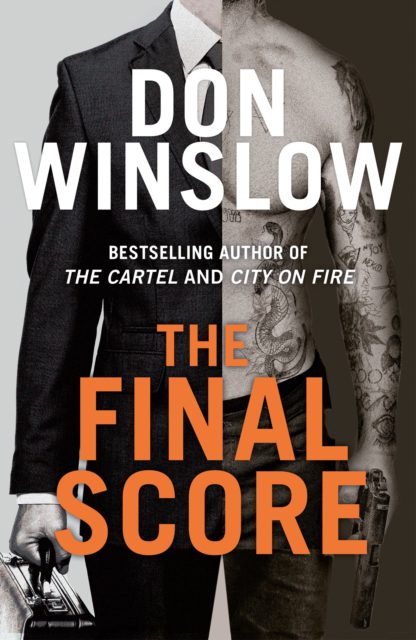
The story that really stands out, however, is The Sunday List, where we see a new side to Winslow. The story of young Nick, son of a trust fund hippie and a stoner musician, who has his sights set on college. To make it pay, however, Nick is working several jobs, most prominently running the Sunday List. In a state that’s dry on Sundays, clients need deliveries on the downlow, and Nick runs the rounds for a local liquor store, a job that soon lands him in trouble… but that’s nothing compared to the trouble his parents bring.
No author’s return has brought me more joy than Winslow’s. The Final Score is a tasty reminder of his generational talent and I hope there is more to come from this most special of crime writers.
By Tom Mooney
The Final Score is published by Hemlock Press and available now!