Welcome to issue nine of The Deep Read, which features news, reviews, articles and essays from the Mr B’s team.
This month, find out how Sam got on at the European Memory Championships, our shop gets a facelift, and Tom gives a trio of novella recommendations…
Adventures in Memory
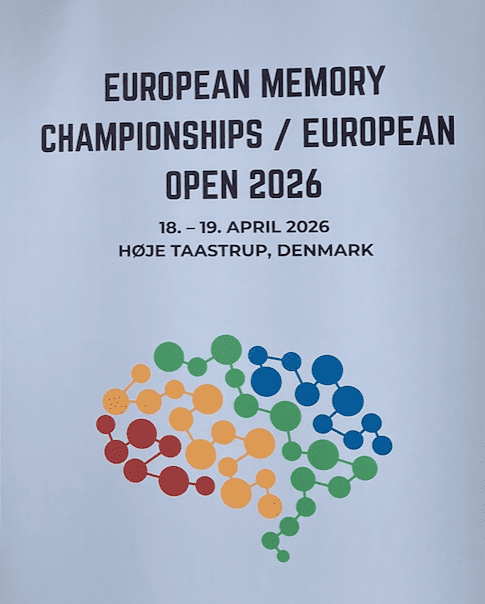
You can climb a mountain, or join a monastery, or stuff your ears with cotton wool in the quiet carriage, but the best silence in the world is found during the Binary Numbers event at an international memory competition. Picture it (if you want): people from Algeria, Austria, Belgium, Brazil, Denmark, France, Germany, Italy, Norway, Saudi Arabia, and one bespectacled bookseller from the United Kingdom, all staring into a field of zeroes and ones, barely breathing or blinking, for thirty minutes. It’s very peaceful, if a bit weird.
This is where I found myself at the end of April: representing the United Kingdom in memory sports in a venue on the edge of Høje Taastrup in Denmark. In this article, I’ll tell you a bit about the people and techniques involved, and my own experience. I’ll also show you a fabulous t-shirt designed by famous Mr B’s bookseller Ed Scotland, and reveal whether I brought glory or shame to the country.
Who are these awesome people?
The common assumption is that competitive memory athletes are bound to be men, and probably single, because everybody else has more important things to do. Well, half of the top 10 athletes at the European Open were women. I don’t know if they’re single, it’s rude to ask. Elite Belgian athlete Céline De Luca came second overall in the competition, flanked in first place by generational talent Enrico Marraffa who quietly broke three world records, and Sylvain Arvidieu in third place.
Getting into the sport, I had assumed that the people who are really good at it would be really bad at other things like social interaction and physical sports, but that’s entirely wrong too. Most of the people in that room were also sports players and athletes (Sylvain is an open water swimmer nicknamed ‘The Flying Frenchman’ who has swum the English Channel). Lots of them have really impressive and varied careers. They’re all great to talk to, often funny, very generous when sharing their experience and knowledge. There’s a special, specific camaraderie you experience when you hang out with a group of people whose interests might be considered odd anywhere else. That’s my favourite part of these competitions.
Some memory athletes are professionals who have become interested in memory to give them an edge in their field. Others found the hobby through an interest in brain functionality, intending to become better learners and thinkers and to stave off cognitive decline later in life. A handful just love pushing themselves in competitive hobbies.
For me, it’s a bit of all of the above, but also a bloody-minded joy in getting good at something I’ve always been bad at. I don’t come from a place of having any innate talent to build upon; I come from a place of refusing to be weak at something I think is important. Similarly, I spent my twenties as a musician because I was painfully shy and frightened of being in front of people. I’ll never be the world’s best people-person, but without putting myself through that I’m confident I’d never have left the house. What I’m trying to say is I think it’s funnier to pursue something you’re completely ill-suited to, rather than following your talent. It’s also more helpful for everybody else: if you want to be able to remember things, I’m better able to help than the person with the innate talent for it, because I’ve improved from a shin-high low bar.
How are these awesome people so awesome?
Each of them is sustaining and building upon an “art of memory” created by the Ancient Greeks. The general technique across all ten events in the competitions involves encoding the abstract information into a symbolic scene that you can play out in your head. Once you’ve created the scene that encodes the information you’re trying to memorise, you ‘place’ it in a location within a mental journey. When it comes to recalling what you’ve memorised, you simply go for a mental stroll and decode the scenes. Here’s an example, using the Binary Numbers discipline I described in the cold open.
1101 1011 0111 0001 0001 0111
This is a very boring sequence of numbers. I’m a bookseller so I prefer letters, and they lend themselves more easily to imaginative scenes. Let’s do a bit of encoding (follow along if you want; skip ahead to the pictures if you prefer): imagine that the first group of four digits (1101) have the outline of a capital R if it was having a lie-down: the two lines at the top of the R forming 11, then a gap represented by the 0, then another 1 for the bottom of the R where it kicks out again. Got it? Well done, most people don’t catch on so quickly.
Let’s imagine that the second group of four digits (1011) has the outline of a capital G if it got jealous and also went for a lie-down: a single 1 for the top of the G, a gap represented by the 0 where it curves away, and then 11 for the bottom of the G rising back up.
For the next four groups of four digits (0111, 0001, 0001, 0111) let’s imagine the lower half of M and a nice simple T (these letters have all had their coffee and are standing upright).
That gives us R, G, M, T, T, M. If we treat the couplets as initials (R.G, M.T, T.M), we might think of Rick Grimes, hero of Robert Kirkman’s ‘The Walking Dead’, and boxer Mike Tyson, and a scene might begin to suggest itself: Rick Grimes wearing boxing gloves and about to punch somebody right in the face. But who? In this case it has to be somebody with the initials T.M: perhaps it could be Tom Mooney, fiction lead at Mr B’s Emporium of Reading Delights and quite often the editor of this newsletter. Sorry Tom.
If you’ve read this far you deserve some pictures. Here you go…
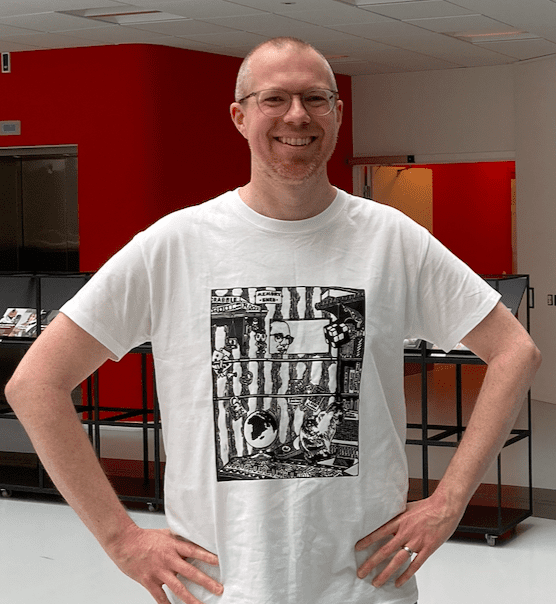
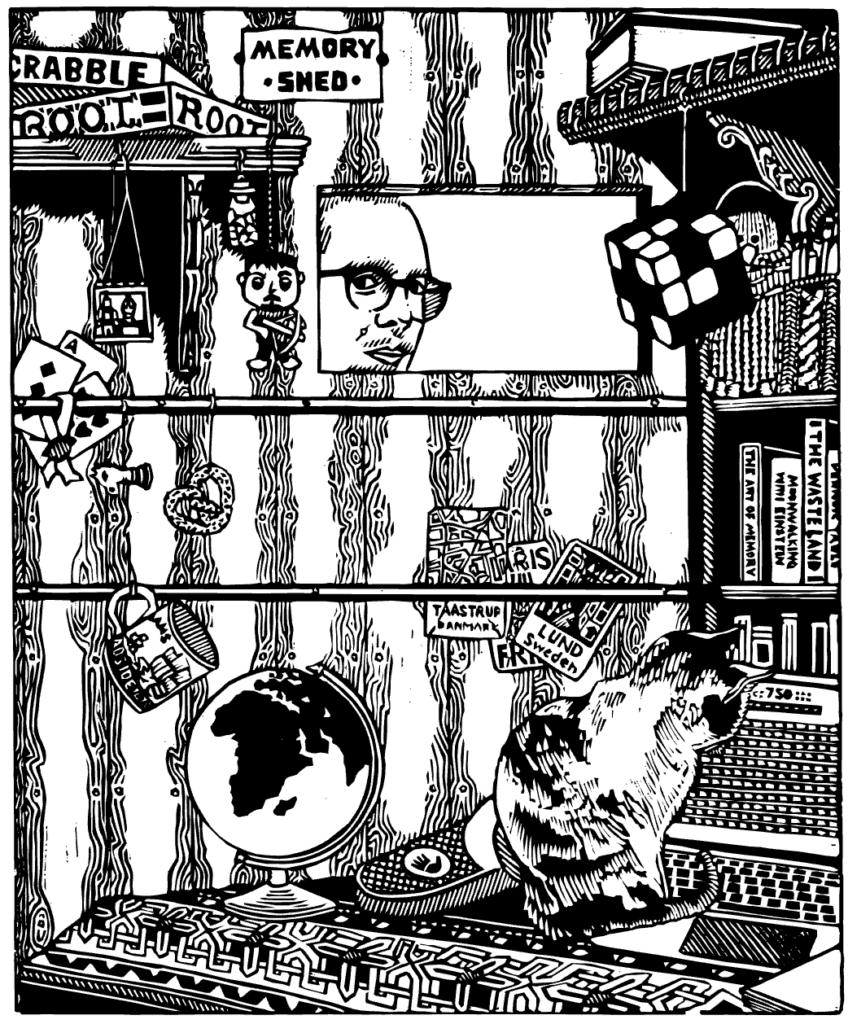
Here I am modelling an Ed Scotland original t-shirt design that he created for me to wear at the European Open, to promote my ‘Memory Shed’ memory coaching Instagram and website. As well as being a famous Mr B’s bookseller, Ed is an amazing artist in his spare time. There’s some awesome hidden details to be found in the picture, including the book that introduced me to the strange world of memory sports, and also my cat. The image is part of Ed’s ‘Working Places’ series: you can find his art on Instagram at ‘edtheranger’. If you want a Memory Shed t-shirt of your own, visit samsmemoryshed.com. It will be the most niche t-shirt in your wardrobe.
Is the United Kingdom awesome at this?
Not bad. I came 13th overall in the competition, a really nice improvement on my previous placements (34th at the World Memory Championship in 2024, 30th at last year’s French Open). At the World Memory Championship there was a Welsh athlete called Daniel Evans, so I was only allowed to represent England, but for the last two years I’ve been representing the entire United Kingdom alone in the live competitions. My ambitions for the future include a world record in the Pi Matrix challenge (https://www.worldpifederation.org/Pi%20Matrix.html) and a top-10 placement in my next competition, but I’d also love to inspire and help some other people from the UK to give it a go. It’s cooler than you think.
Thanks if you’ve read all the way to the end of the article. Hope you have a great rest of your day.
by Sam Drew
Mr B’s Gets a Facelift
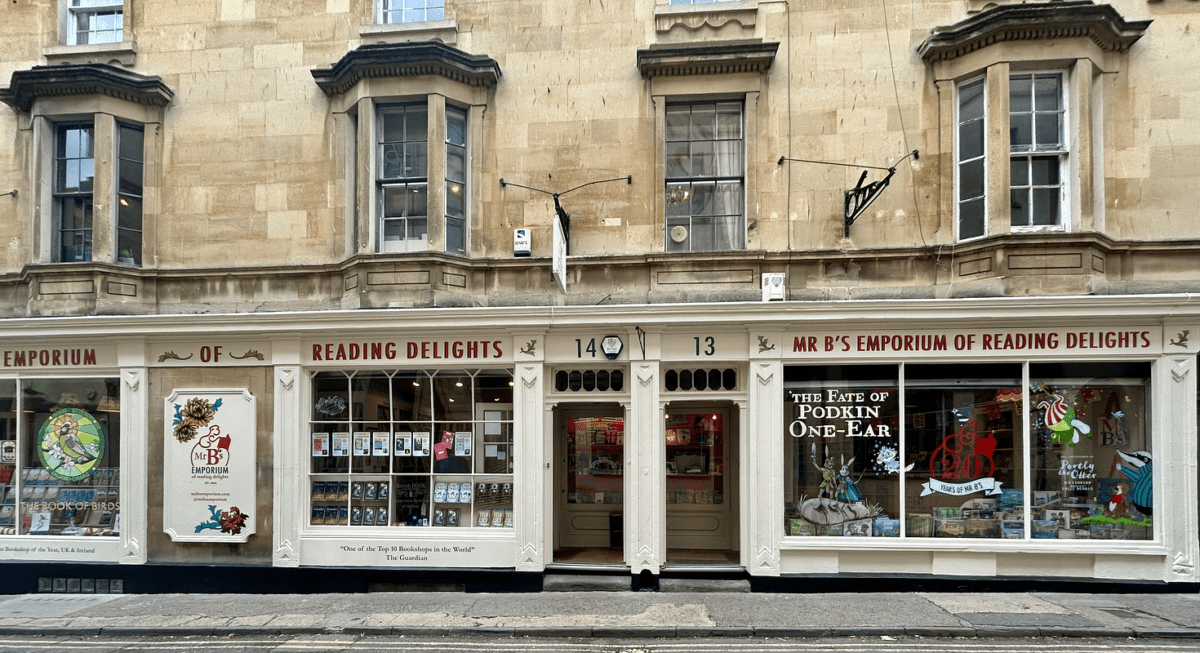
Our lovely long shop frontage has had a refresh. It had been hidden away under scaffolding for a few weeks and emerged all glamorous and looking ready for our 20th party on 4th/5th July.
A huge thanks to friend and painter-decorator Jackie Gillespie and artist Alex Lucas for their incredible hard work in the scorching heat getting it ready and giving it a beautiful refresh.
A Trio of Novellas
I have always been a big fan of short, sharp novels, where not a word is wasted and a compelling idea or character is brought to life in little more than 100 pages. A novella also makes for perfect back-pocket fare for parks and beaches in summer. I have read three contrasting beauties in recent weeks…
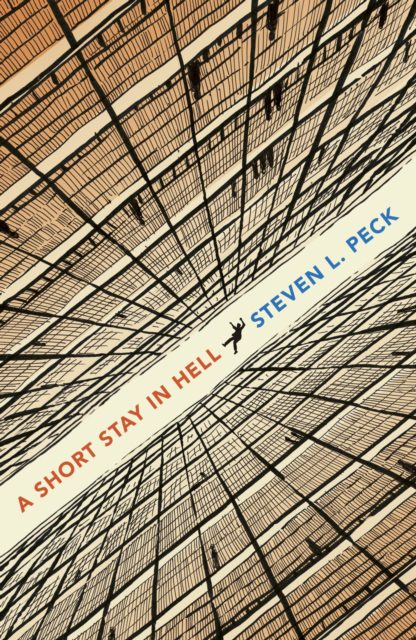
A Short Stay in Hell was first published in the US two decades ago, and now gets its first UK publication thanks to Vintage Classics. Steven L. Peck‘s existential dystopia opens with a group of mostly pious Americans having recently died and been thrust into a hell-bound meeting with a demon. It turns out there was one true religion and one God… unfortunately for all involved, they were praying to the wrong one. But all is not lost! The Hell into which they’ve been thrown is an infinite library: to escape they just have to find the book that tells the story of their life. Acerbic wit, bloody horrors, and existentialist mind games make this one of the best books I have read this year.
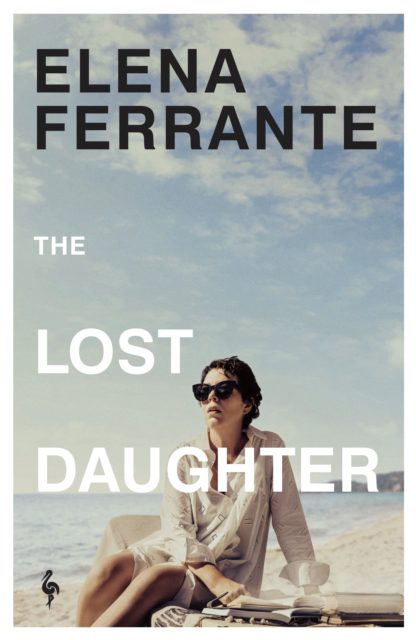
Elena Ferrante has been a favourite for millions of English language readers for more than a decade now, since her Neapolitan Quartet was translated by Ann Goldstein and published by the excellent Europa Editions. Her novella The Lost Daughter is a perfect lesson in how to fully develop character in just a handful of pages. Leda – middle aged, divorced, plagued by guilt – is spending the summer at the beach, where she hopes to get some reading and writing done under the blistering Italian sun. But she soon runs afoul of a group of brash Neapolitans that sours her very existence in this idyllic place. An incredible psychological study of motherhood, class and jealousy.
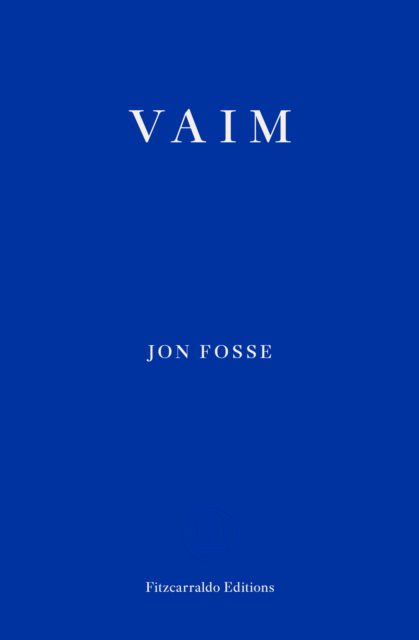
Vaim is the latest work by the Norwegian Nobel Laureate Jon Fosse – his first since receiving the award. It opens with the story of Jatgeir, a lonely islander, as he heads to the mainland looking to buy a needle and thread to sew a button back on his shirt. When he is swindled by a shopkeeper in the city, he leaves in bitterness and heads for another island, returning to the company of people more like himself. There, for the first time in decades, he sees his teenage sweetheart Eline, after whom his boat is named. But this is not the chance encounter it seems, and other forces are at play. A strange, beguiling, and hypnotic tale of love, longing, and loneliness by a master at the top of his game.
by Tom Mooney